For agencies, consultancies, recruiters and B2B sales teams on Google Workspace

Every email worth a reply, drafted in your voice within 5 minutes.

Two agents on your own Google project. One drafts the replies waiting in your inbox, one writes the cold emails your pipeline needs. You read, you edit, you send. Nothing goes out without you.

The deliverable: a draft in the thread, within 5 minutes, for every email that needs one.

Install zero is our own inbox. Day one, 10 drafts: two thirds went out as written or lightly edited.1

Gmail · install zeroFri 6 Nov 2026 · 17:35
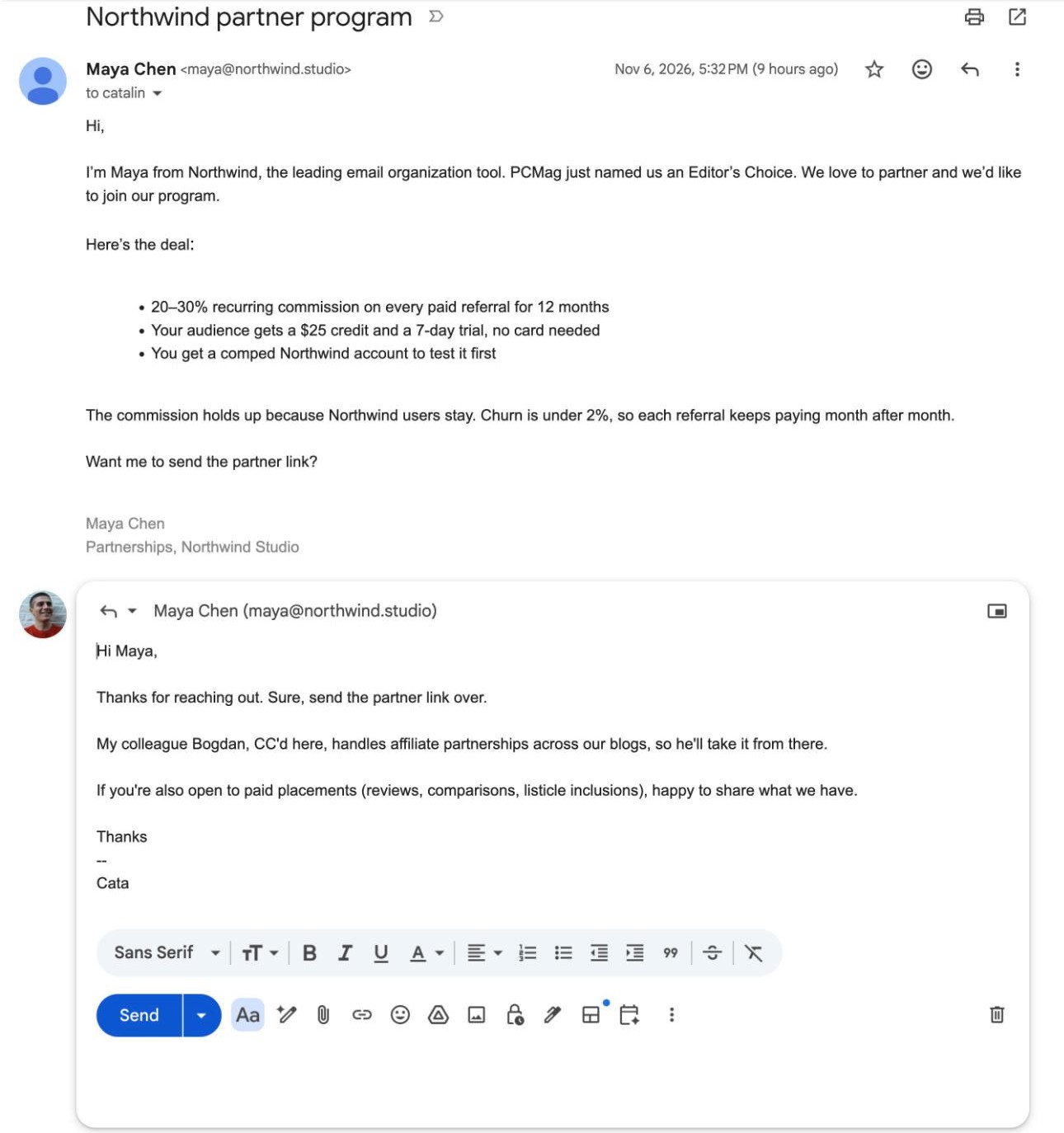
A real Gmail thread from install zero: a cold partnership pitch, and under it the reply Lyne drafted in Cata's voice, waiting in the compose box next to Gmail's own Send button.
As found. A cold partnership pitch came in at 17:32; this is the reply Lyne left under it, in Cata's voice, with the colleague who actually handles partnerships looped in. The sender's name and company were changed. The blue Send button is Gmail's. Lyne has none.

Install zero

We run it on our own inbox first.

A morning from the decision log, in the format it's written. Sender names changed, everything else as logged. Yours gets measured the same way before any monthly starts.

  • 10 drafts1

    on day one. Two thirds went out as written or lightly edited.

  • 183 threads2

    read in the first eval. 147 skipped by rules, at $0 of model cost.

  • $0.313

    for the whole first run. Under $10 a month at 30 human threads a day.

tenants/cata/logs/2026-11-05.lognext run in 4:58 · at 03:30
03:20  skipped     1a1a911a3a717792  "Weekly product digest"              newsletter/list
03:20  skipped     1a1ae91cf6a324a6  "Your receipt from the print shop"   automated sender
03:20  skipped     19f8fdabcc7b6236  "Re: proposal v3"                    Cata wrote last
03:21  no-reply    1a1aa6ef2e6b3c42  "Re: invoice Oct 2026"               a thank-you closer, nothing asked  $0.005
03:25  drafted     1a1a90b7b038faae  "Kickoff timing + revised quote"     client · asked two questions   lint=0  $0.02
03:25  held        1a1b0a200d50879d  "Re: the March thread"               draft had a gap (date unknown), not created
03:26  skipped     1a08c7c0c1f88362  "Update pass on the review"          draft already in thread
03:30  tally       week ending 2026-11-05: 11 drafts · 6 edited · 3 rewritten · 0 discarded · acceptance 67%

What gets installed

Two agents, one inbox.

The email assistant

Every email that needs an answer gets a draft inside the thread, within 5 minutes.

Built from your sent folder, so day-one drafts already sound like you.

  1. Every 5 minutes it reads the new threads in your inbox.
  2. Rules skip newsletters, notifications, receipts, and threads where you wrote last. No model touches those.
  3. For the rest, a small model decides: does this need a reply, and in which register (the friend, the client, the formal one).
  4. A bigger model writes the reply from your sent mail, the thread, and your last 3 threads with that sender.
  5. The draft lands under the last message in Gmail, in your own font and style. You read, edit, send.
  6. Every thread gets a label: Drafted or No reply. Add Redraft to any thread and it drafts it regardless.
  7. It never invents a price, a date or a promise. A gap goes to the log, and the draft is held.
  8. It learns from what you send: your reply is compared to the draft, and the lessons go to plain text files you can read and edit.
  9. Every Monday you get the count: drafts kept, edited, rewritten.

The outreach manager

A 3-email sequence per prospect, written from what their own website says.

You approve the batch before anything moves.

  1. You give it a list: company, domain, first name, email.
  2. It reads each homepage and demo page, counts the form fields, looks for a calendar embed, and notes one true thing about them.
  3. It writes 3 emails per prospect in your voice: one observation, then the offer that fits, then the call.
  4. Everything lands in one batch file. You mark each prospect keep, edit or wrong, and fix the text in place.
  5. Only keep and edit rows export to your sending tool. A push needs an explicit go.
  6. Prices, links and claims come from a context file you wrote. It can't use a number it wasn't given.
  7. Replies come back to Gmail, where the email assistant drafts the answer.

One row of the batch file (fictional prospect)

prospect   Helio Data · helio.example · Dana
found      7-field demo form, no calendar, "we'll be in touch" with no time on it
email 1    day 0 · one observation + a yes/no question
email 2    day 4 · the offer
email 3    day 9 · the call
mark       [keep]  edit  wrong

You read, you send

Nothing leaves without you.

Lyne runs inside accounts you already own. Mail is read on your Google project and sent to the model on your API key. Every decision is written to a log with its reason and its cost, so a miss is one search away. A draft with a gap is held, never created. Disconnect by revoking one token.

gmail scope    gmail.modify            # read, drafts, labels. no send call in drafter.py
auto-send      none                    # there is no setting for it
held drafts    gap found -> logged, not created
stored         logs/, out/, learned/*.md   # mail bodies are not stored
runs on        your Google Cloud project · your server · your API key
exit           revoke one token

The learned files are plain Markdown. Open them, edit a line, and the next run uses it.

The only thing the code can make is a draft. There is no send call in it, and no setting to add one.From the install notes

The install

From first call to live. Then it's yours.

Step 130 minutes

The call.

We read your sent mail together and build the voice guide: who gets "hey", who gets "Dear", your sign-offs, what you never commit to by email. You edit it, and we tell you if it's a fit.

Step 2About 20 minutes of your admin

Your project, your server, your key.

Lyne runs on your own Google Cloud project and your own server, with your own API key. Nothing routes through us.

Step 3Before any monthly

The 10-run eval.

10 real emails get drafts. You mark each keep, edit or wrong. We tune, you decide. You see 10 real drafts before any monthly starts.

Step 4Every 5 minutes

Live.

Drafts every 5 minutes, batches when you want one, the acceptance count in your inbox every Monday. The code, the prompts and the learned files sit in your accounts. Leave with one revoked token.

Why an install

Replace the per-seat drafting tools with one install on your own account.

The drafting toolsLyne
A generic draft from a prompt box. Gmail's own Help me write starts from a blank prompt.Starts from the thread, the sender history and your sent mail. No prompting.
They guess what matters, and the guessing is what creates the manual work.Every "no" is labelled and logged with its reason. You move a sender between the lists.
They file, archive or send on their own.Drafts only. There is no auto-send setting.
$12 to $200 a seat, per month, on their servers, with your mail.A flat install on your own Google project and server. Your mail never leaves your account.
No context: it doesn't know what you agreed on the call.Learns from every reply you send; notes and docs feed the knowledge file.
TBD

One install price. No seats.

A setup fee plus a flat monthly per inbox, a 3-month term and a written exit. The numbers get set after the first diagnostic calls, and they'll be exact ones.

Book a 30-minute install call. We read your inbox together, show you what gets skipped and what gets drafted, and tell you if it's a fit. The call settles:

  • The setup fee
  • The monthly, per inbox
  • A 3-month term and a written exit
Book a 30-minute install call

1 Install zero = Cata's own Gmail. The 5 Nov 2026 eval wrote 10 drafts; the week's tally (ending 5 Nov) counts 11 drafts, 6 sent with light edits, 3 rewritten, 2 still open: 67% acceptance.

2 The 5 Nov 2026 eval: 183 inbox threads looked at, 147 skipped by rules with no model call, 36 judged by the small model, 10 drafted by the large one.

3 $0.31 of model cost for that whole run, voice guide cached. The monthly estimate assumes 30 human threads and 10 drafts a day.